The official component list totals 148 gameplay cards plus 5 Player Aid cards: 153 cards when the aids are included. This counts physical cards, not unique designs. Starter, acquisition, location, Library Book and event cards have different jobs and should be sorted separately.
Based on the publisher’s rulebook ↗Start by recognizing the card in your hand
First separate cards you play for actions from cards that describe destinations. These examples are taken directly from the official card guide; its numbered callouts are retained.
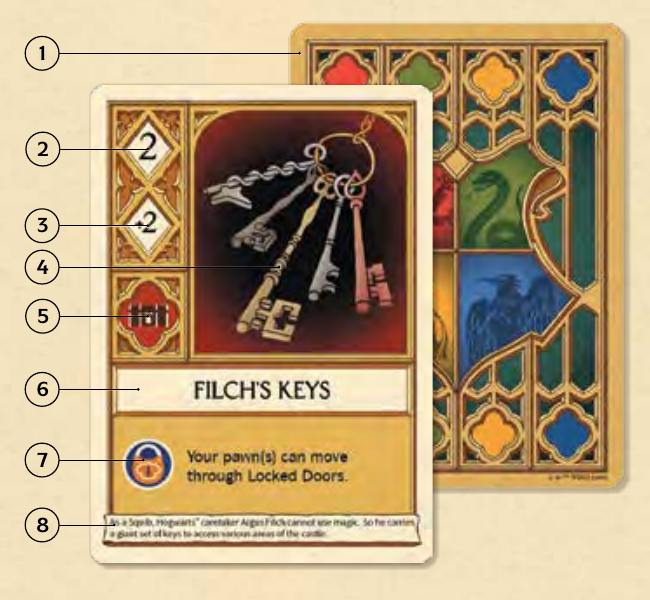
House action card
Look at 2 / 3, then 7: movement values first, then the effect. Number 5 is the card type; 6 is the name. The small story text at 8 is not an extra rule.
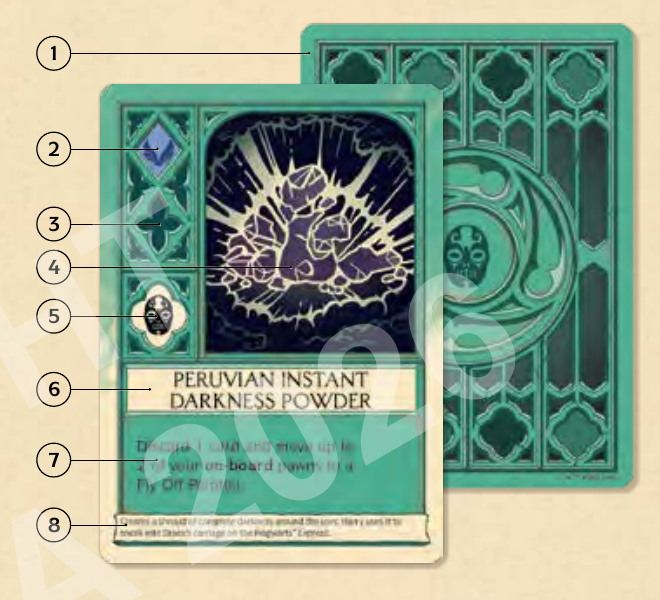
Dark Arts action card
Check 5 before 7: the colour indicator tells you whether its effect is unlocked. Movement and effects are different parts of the card.
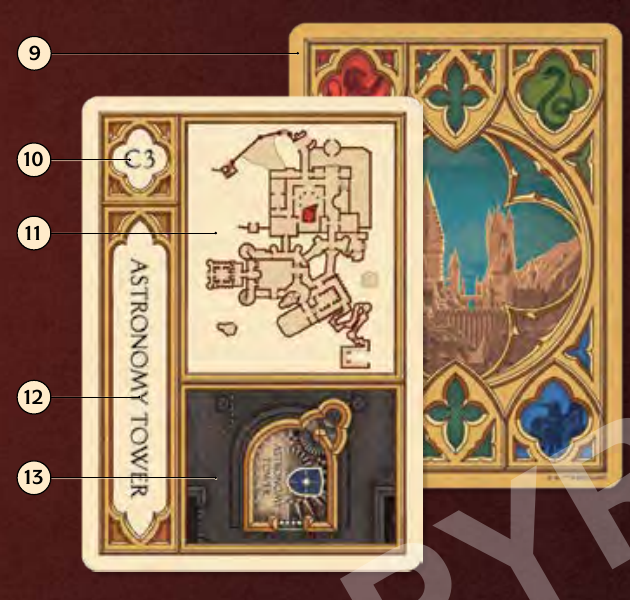
Location card
Find 10 / 11 / 12: coordinates, map and location name help you locate the destination. This is an objective reference, not an action card to discard for movement.
Card diagrams: © MinaLima 2026. Excerpts from printed pp. 14–15; original callouts and visible watermark retained. Tap an image to enlarge.
Official rulebook · printed pp. 14–15 ↗Try reading the example before your first turn
Use the House card above for a quick check. Open each answer after making your guess.
The card shows 2 + 2. Can I move one pawn four spaces?+
Yes, up to four spaces along a legal route. Alternatively, move two different pawns up to two spaces each. You cannot split it into one plus three.
Official rulebook · printed pp. 16–17 ↗Does the movement value let me pass every obstacle?+
No. The effect on Filch’s Keys allows movement through Locked Doors; it does not grant permission to cross every obstacle or castle walls.
Official rulebook · printed pp. 14–15 ↗Official rulebook · printed pp. 10–11 ↗I just learned a new card. Can I play it from my hand now?+
The acquired card goes on top of your draw deck, not into your hand. You would need another permitted effect to draw it and permission for an additional action to play it this turn.
Official rulebook · printed pp. 16–17 ↗Card counts at a glance
The totals below are calculated from the component list in the linked rulebook. They do not include unlisted promotional or expansion content.
| Card group | Count | Purpose |
|---|---|---|
| House starter cards | 28 | Four decks of seven. Each House starts with the same set of card abilities. |
| House acquisition cards | 42 | Shared supply for improving House decks through Learn and other permitted effects. |
| House location cards | 21 | Personal destination requirements used to earn Parchment Scrolls. |
| Library Book cards | 11 | An immediate effect plus an item needed for a Defence Shield. |
| Dark Arts starter cards | 7 | The Dark Arts player’s starting deck. |
| Dark Arts acquisition cards | 20 | A separate supply for the Dark Arts deck; bumping is one way to acquire from it. |
| Dark Arts location cards | 4 | The destination for the Dark Arts endgame objective. |
| Event cards | 15 | Three colour decks: five white, five orange and five red. |
| Player Aid cards | 5 | Reference cards, separate from the 148 gameplay cards. |
| Total, including aids | 153 | 148 gameplay cards + 5 reference cards |
Do I start with all seven cards in hand?
No. Each player has a seven-card starter deck and draws five cards for the opening hand. Unused House decks stay out of the game. The four House starter decks share the same card abilities; Dark Arts has its own starter deck.
When your draw deck runs out, shuffle your discard pile to make a new one. Cards you play can therefore return to your hand later.
Official rulebook · printed pp. 8–9 ↗Official rulebook · printed pp. 12–13 ↗How do I read an action card?
- Movement: read the movement value or movement symbols. A single value moves one un-stunned pawn up to that number of spaces. A multi-move card has two values with specific allocation rules.
- Effect: read what the card permits, its conditions and timing. Movement and effect can normally be resolved in either order. A lightning-bolt symbol identifies a reactive effect with a trigger.
- House type or Dark Arts colour: House cards have a type that can match a Hogwarts Token. Dark Arts effects have white, orange or red indicators showing when they unlock.
- Name and narrative text: distinguish descriptive story text from the card’s actual effect instructions.
Use the publisher’s labelled card diagrams to locate these fields on your physical cards.
Official rulebook · printed pp. 14–15 ↗Official rulebook · printed pp. 16–17 ↗Official rulebook · printed pp. 20–21 ↗What makes acquired cards different?
Acquisition cards expand your deck’s available movement and effects. They are not automatically available in your hand when acquired: normal Learn acquisitions and the Dark Arts bump acquisition go face-down on top of your draw deck.
House cards
Learn lets you choose a face-up normal card or the top of the acquisition deck for one discard. An advanced face-up card costs two discards and also advances Loyalty.
Dark Arts cards
Effects become usable by colour: white from the beginning, orange from the first orange track space and red from the first red space. Earlier colours remain unlocked.
Editorial advice: choose a card to solve a specific route or timing problem. A card’s name or artwork does not establish that it is stronger.
Official rulebook · printed pp. 16–17 ↗Official rulebook · printed pp. 20–21 ↗Location cards and Books are not ordinary action cards
House Location Cards identify map destinations. Occupying two of your three listed areas at once earns a Scroll under the location procedure.
Dark Arts Location Cards identify where its required pawns must gather to complete the endgame objective.
Library Book Cards are obtained at the Library. Resolve the chosen Book’s effect immediately, then keep it on your player board as an item. You may hold only one Book at a time.
Official rulebook · printed pp. 10–11 ↗Official rulebook · printed pp. 16–17 ↗Official rulebook · printed pp. 22–23 ↗How do event cards work?
Reaching an Event Space triggers the matching colour deck. First resolve the House portion where possible; then Dark Arts chooses its event benefit or the available Progress Token for that zone. A zone’s token must be taken before advancing into the next zone.
Event cards are not part of a player’s action hand. Keep the three colour decks separate during setup.
Official rulebook · printed pp. 22–23 ↗Put the cards into play
This is a guide to the card groups and their rules, not a complete named-card database. The rulebook does not provide a full text list of every acquisition card; individual card text remains the reference for its exact effect.